
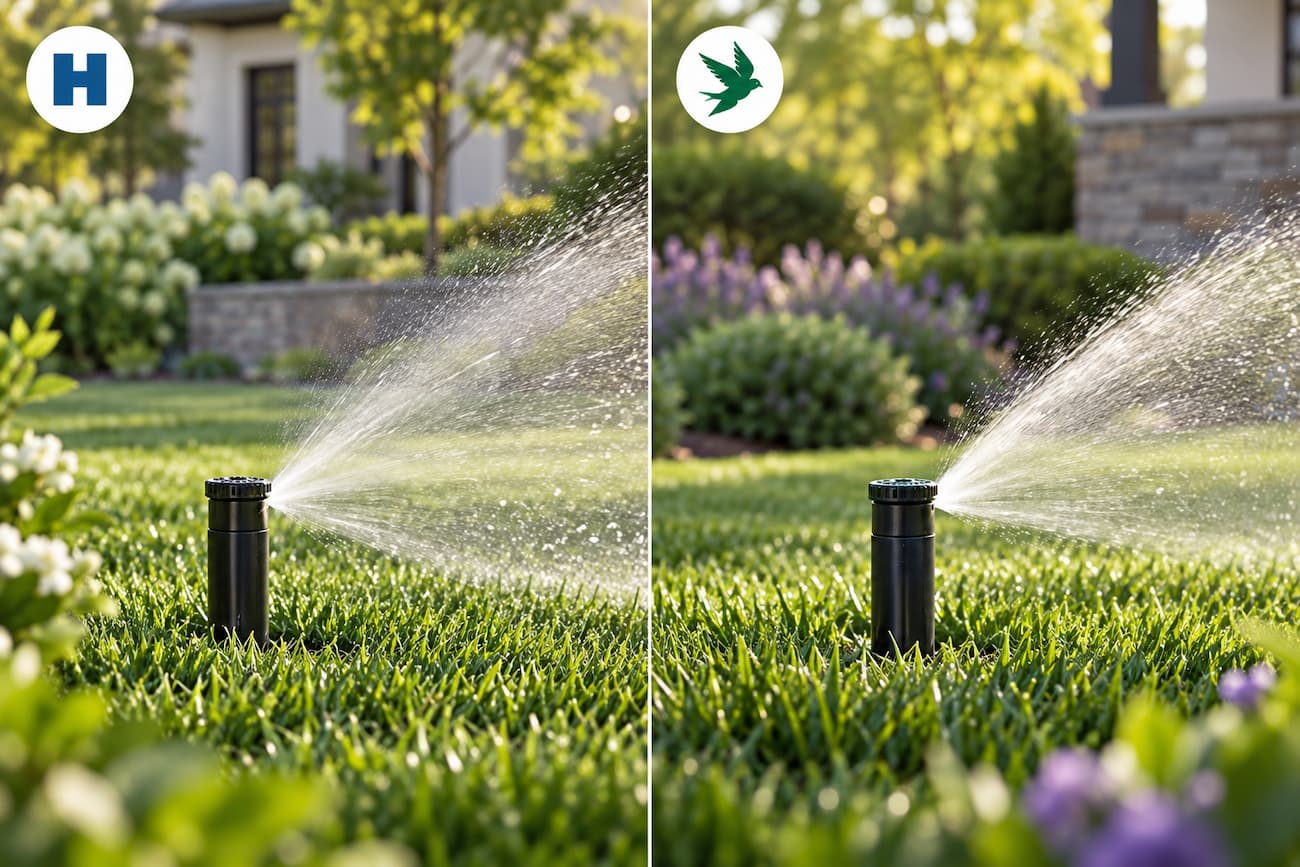
Hunter vs. Rain Bird: Which Sprinkler System Lasts Longer in Westchester and Fairfield County?
Sooner or later, every homeowner putting in a new sprinkler system, or finally replacing one that has seen better days, comes to the same fork in the road. Hunter or Rain Bird. Both are American companies. Both build professional-grade equipment that shows up on properties from Scarsdale to Ridgefield. And both have salespeople who will tell you their brand is the one that lasts.
Most of the comparisons you will find with a quick search were written for a national audience, and they tend to call almost everything a tie. That is fine if you live somewhere flat and sandy. It is not much help if your address is in Bedford, Westport, Nyack, or Carmel, because our conditions are not national. Anything we put in the ground here has to survive a frost line that can reach 42 inches, rocky glacial soil loaded with clay, tree roots working their way into everything, wide swings between soggy summers and dry Septembers, and more than twenty years of being shut down every fall and fired back up every spring.
So we are going to ask one question and answer it honestly: which brand holds up longer on a property in Westchester County, Fairfield County, and the surrounding counties?
Here is the short answer, and then we will walk through why. Hunter wins the categories that matter most on a residential system in our region: rotors, spray heads and nozzles, and controllers. Rain Bird earns the win on drip irrigation and holds even with Hunter on valves. Read on for the reasoning, part by part, and then we will get into the installation choices that matter even more than either logo on the box.
“People call and ask which brand is better. I tell them the brand is the third question. The first is who designs the system, and the second is who winterizes it. Get those two right, and the brand question mostly answers itself.” — Pasquale Falco
What Your Sprinkler System Is Up Against Here
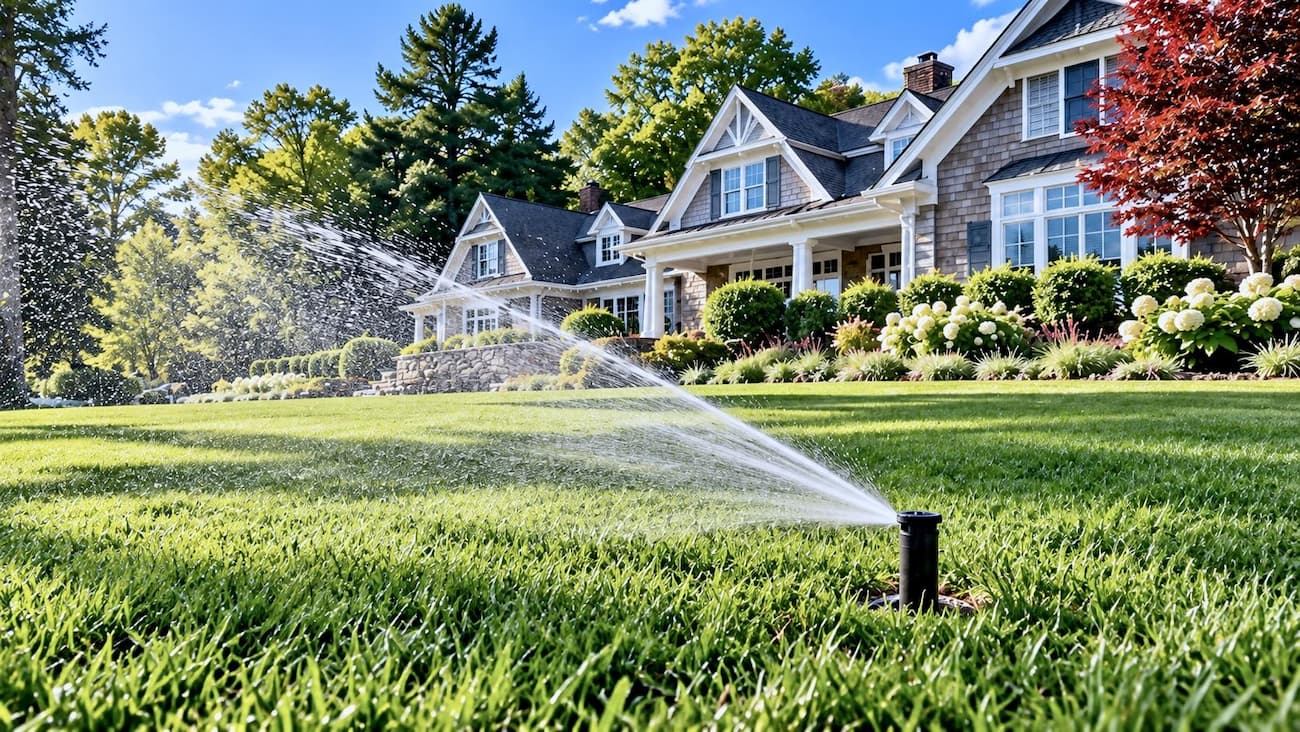
Before comparing parts, it is worth being honest about what actually breaks sprinkler systems in this part of the country. It is almost never the brand stamped on the head. It is the ground and the weather.
- The frost line. Connecticut’s building code puts frost depth at 42 inches, and Westchester, Putnam, and Rockland run in a similar range, deepening further as you head north into Dutchess and Orange County. Sprinkler lines are never buried that deep, so every pipe, valve, and head on your property freezes solid each winter. Any water left inside expands and splits whatever contains it, which is why winterization matters more than any single product choice.
- Freeze and thaw heaving. The ground around every head moves over time. Heads tilt, sink, or pop up above grade where the mower finds them. Heads that adjust from the top, without digging, survive this cycle well. Heads that have to be pulled and reset every time do not, because every dig disturbs the fitting underneath.
- Glacial soil. Most lots across Westchester and Fairfield sit on compacted, rocky glacial till carrying a lot of clay. Clay absorbs water slowly. Apply water faster than the soil can take it, and it runs off, pools in the low spots, and leaves the high spots dry. Nozzles that apply water gently do better here, and where the water simply sits after every cycle, the real fix is often a drainage solution, not a different sprinkler head.
- Rock. Opening a trench in Pound Ridge, Wilton, or Cold Spring usually means hitting ledge sooner or later. Once a system is buried, you do not want to reopen the ground for routine maintenance, which is why above-ground serviceability is genuinely a durability feature in our soil.
- Wet summers, dry stretches. The heavy rainfall of summer 2026 kept plenty of systems switched off for weeks, and then September turned dry. A controller that reads local weather and adjusts itself, rather than running a fixed schedule regardless of conditions, protects the lawn and the water bill from swings like that.
“Every property we walk in this area has the same three enemies: frost, clay, and rock. I look at every piece of equipment through that lens. If it cannot stand up to those three, I do not care what the spec sheet says.” — Pasquale Falco
Rotors: The Heads That Water Most of Your Lawn
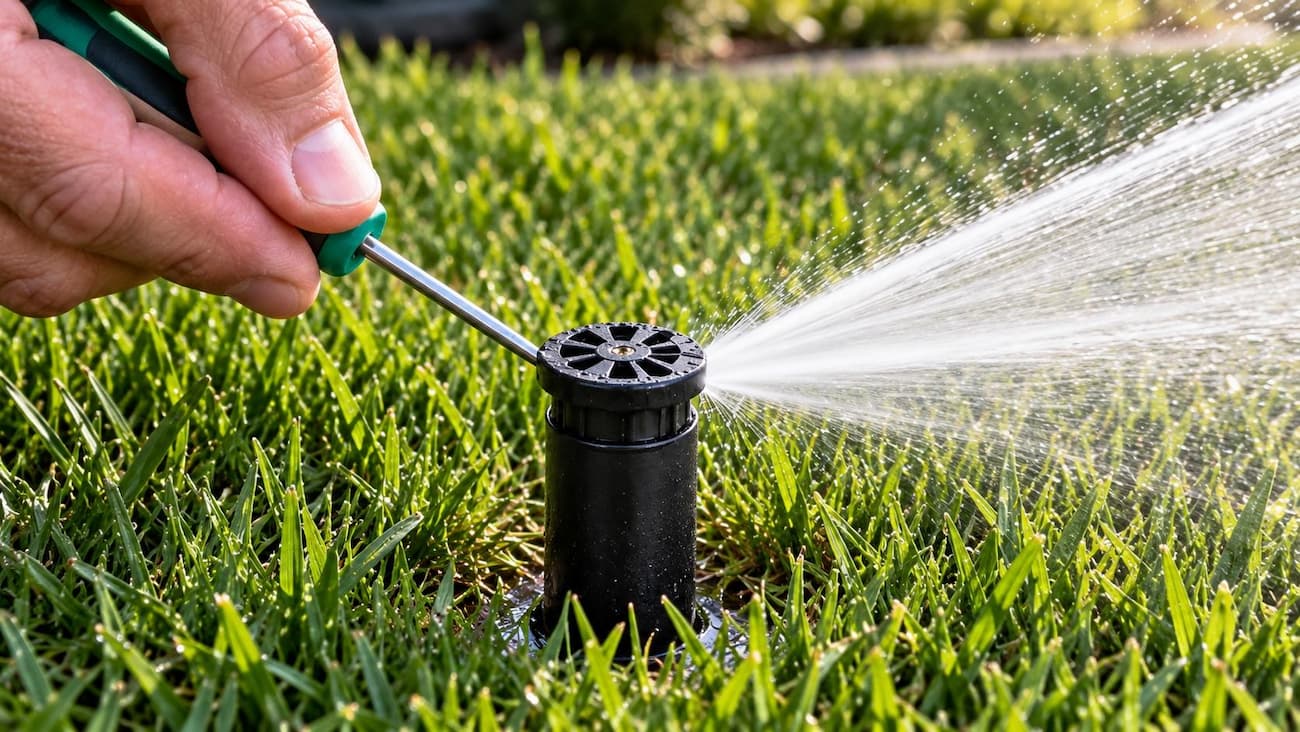
Rotors are the gear-driven heads that sweep a stream back and forth across open turf. On a typical half-acre lot in Armonk, Fairfield, or Suffern, rotors cover most of the lawn, making rotor durability the single biggest factor in how long the whole system lasts.
Hunter PGP Ultra. Hunter’s flagship residential rotor. The arc is set from the top with a flat-head screwdriver, and the internal gearing is built so it cannot be stripped by forcing the arc past its stop. It carries a five-year warranty from the date of manufacture, and optional check valves keep water from draining out of low heads on a slope and puddling after every cycle.
Rain Bird 5000 series. A capable rotor with plenty of loyal contractors behind it. Its Rain Curtain nozzles are built to hold a tight stream in wind, and the 5000 Plus version adds a flow shut-off right at the head. It also carries a five-year trade warranty, and Rain Bird’s own literature makes a solid case for the strength of its wiper seals and check valves.
Why Hunter wins here. On paper, the two are close. In our ground, the difference shows up in year four and beyond. Heaving and settling mean that every rotor on your property will need attention several times over its life. The PGP Ultra’s top-adjust arc and gearing that will not strip mean those adjustments take thirty seconds, from above ground, without disturbing the fitting below. A rotor that stays put and gets serviced from the top simply outlasts one that has to be dug up, and on rocky lots, that gap is not a small one.
“I have pulled rotors out of lawns in Katonah that went in twenty years ago and were still running fine. The ones still working are always the ones nobody ever had to dig up. The PGP lets you do everything from the top, and that is really the whole story on why they last here.” — Pasquale Falco
Winner: Hunter
Spray Heads and Nozzles: The Parts That Fight Our Clay
Spray heads are the short pop-ups that cover beds, side yards, and smaller sections of lawn. The body matters less here than the nozzle sitting on top of it. For a plain-English rundown of how the pieces fit together, our sprinkler heads FAQ covers the basics.
Hunter MP Rotator. This nozzle turns an ordinary spray body into a mini rotor that emits several slow, rotating streams instead of a single hard spray. It applies water at a fraction of the rate of a standard nozzle, which, on clay soil, is the difference between water soaking in and water running down the driveway. It also holds its pattern in the wind far better than a fan spray.
Rain Bird 1800 series and MPR nozzles. The 1800 body is a durable, well-proven spray head, and Rain Bird offers the widest range of matched-precipitation-rate nozzles built for it. Rain Bird also makes its own rotary nozzle, the R-VAN, which competes directly with the MP Rotator.
Why Hunter wins here. The MP Rotator has been on the market longer, comes in more nozzle sizes, and is what most contractors around here reach for the moment a spray zone starts producing runoff. Its slow application rate answers the drainage problem that defines our soil, and there is a real cost benefit too: zones running MP Rotators use less water per season, which matters on municipal water in White Plains or Stamford, and matters even more on a well in northern Westchester, Putnam, or Easton, where every gallon pumped is wear on the pump.
One practical note worth knowing: the MP Rotator screws directly onto a Rain Bird 1800 body. If your property already has Rain Bird spray heads, problem zones can be converted without replacing the bodies underneath.
Winner: Hunter
Controllers: The Brain of the System

The controller decides when each zone runs and for how long. A basic controller follows a fixed schedule no matter what the sky is doing. A smart controller reads local weather and adjusts on its own.
Hunter Hydrawise (Pro-HC, HPC, HCC). Hunter’s Wi-Fi platform. Its Predictive Watering feature pulls temperature, forecast rainfall, wind, and humidity for your exact location and adjusts run times daily, skipping cycles when rain or a freeze is on the way. Paired with Hunter’s flow meter, the controller learns the normal flow through each zone and then flags anything unusual: a broken head or cracked line running high, or a stuck valve running low. The homeowner app is simple, and a contractor dashboard means we can often spot a problem and diagnose it before anyone drives out to the house. Hunter’s standard Pro-C controller can also be upgraded to Hydrawise later with a simple face-panel swap. Our guide to the key parts of your irrigation system walks through how the controller, sensors, and valves work together.
Rain Bird ARC8, ESP-Me3, and the LNK2 module. Rain Bird’s residential controllers are reliable and straightforward to program right at the panel. Wi-Fi comes through the LNK2 module, which plugs into the controller and connects through the Rain Bird app. Weather-based adjustment works at the zip code level. Both brands’ smart controllers carry EPA WaterSense certification and qualify for utility rebates where available.
Why Hunter wins here. For long-term system health, the flow meter integration is the deciding feature. A cracked lateral line under a lawn can run for weeks without ever showing on the surface, wasting thousands of gallons and undermining the soil above it the entire time. Hydrawise, paired with a flow meter, catches that within a single cycle. Rain Bird’s residential app does not offer an equivalent today. Add in the freeze skip, the more localized weather data, and the contractor-side visibility, and the gap becomes clear.
“The flow meter has changed how we handle repairs. We had a customer in northern Westchester with a cracked line under the front lawn, no wet spot, nothing visible from the surface. Hydrawise flagged that the zone was running about 20% high on the very first cycle in April. We found the break within the hour. Ten years ago, a leak like that runs all summer before anyone notices.” — Pasquale Falco
Winner: Hunter
Valves: Where Honesty Matters
Valves sit in a box below grade and open each zone when the controller calls for it. Hunter’s PGV and ICV compete closely with Rain Bird’s DV and PGA. Both use globe-style bodies designed to keep internal parts contained during service. Hunter’s PGV includes a flow control stem and a manual bleed on every model, while Rain Bird’s DV uses captive screws, so nothing falls into the mud when the bonnet comes off.
In our region, valves fail for one reason far more than any other: water left sitting inside them over the winter. That is an installation and winterization issue, not a brand issue. A properly placed valve box, a manifold that drains completely, and a thorough blowout every fall matter far more here than whichever name happens to be molded into the bonnet.
Winner: Even
Drip Irrigation: Where Rain Bird Earns Its Reputation
Drip and micro-irrigation water beds, foundation plantings, and vegetable gardens right at the root, with no overhead spray at all. Rain Bird has the deeper catalog here, including XF dripline, XB emitters, and a retrofit kit that converts an existing 1800 spray body into a drip zone. Hunter’s lineup is smaller by comparison, though its HDL dripline and Eco-Mat subsurface system are well engineered.
If your property has extensive planting beds along a stone wall in Katonah, or a foundation garden in Darien, Rain Bird’s drip components give you more options and finer control over exactly where the water goes.
Winner: Rain Bird
The Verdict
For a residential system anywhere in Westchester County, Fairfield County, or the surrounding counties of Rockland, Putnam, Dutchess, and Orange, Hunter is the stronger long-term choice. It wins in the three categories that carry the most weight for durability here: rotors that stay serviceable through years of frost heave, nozzles that respect our clay soil, and a controller that catches a leak before it becomes an excavation project. Rain Bird remains a sound product line in its own right. It wins on drip, matches Hunter on valves, and dominates large commercial and municipal work, where its central control platform has no residential equivalent to worry about.
The two brands are cross-compatible standard connections, which means a Hunter system can carry Rain Bird drip zones without compromise. That, in fact, is how we build most of ours.
“Both brands make good equipment, and I will say that to anyone who asks. What separates them on a property here is what happens in year five, once the ground has moved and the heads need attention. Hunter heads get adjusted from the top and stay in the ground. That is why they last.” — Pasquale Falco
What Matters More Than the Brand
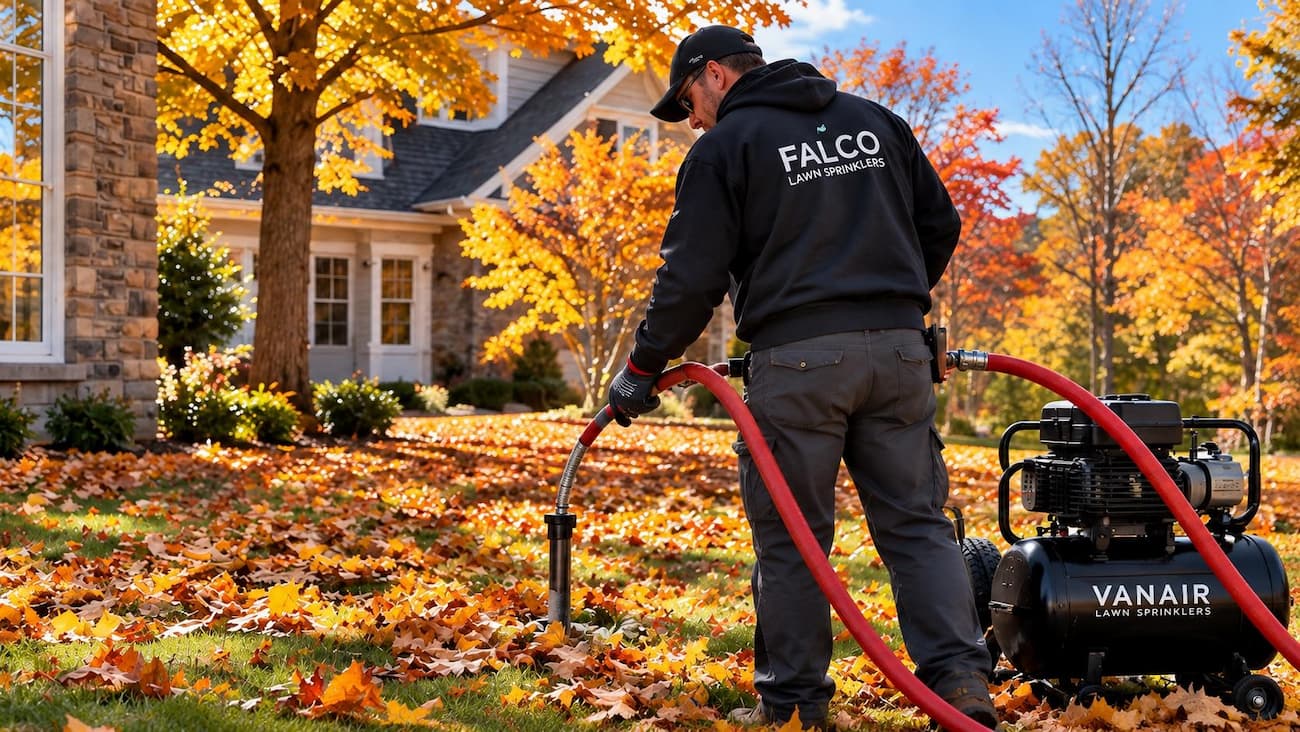
We install Hunter as a Hunter Industries Preferred Partner. But no brand, however good, survives a poor installation. Whatever equipment ends up in your yard, insist on the following from your irrigation installer:
- Polyethylene pipe, not PVC. Poly flexes with freeze-thaw cycles and tolerates a small amount of residual water. Rigid PVC cracks. In our climate, this is not optional.
- Check valves on every head below the zone’s high point. Sloped lots in Chappaqua, Weston, Piermont, and along the Hudson drain toward the lowest head after every cycle. Check valves stop that. Without them, you get a permanent wet spot and a head that fails early.
- Heads set to grade, with swing joints. A flexible swing joint under each head lets it move with the ground and absorb a mower strike without cracking the lateral line beneath it.
- A flow meter. It costs roughly the same as a couple of extra heads, and it is the only part of the entire system that can tell you a line has broken underground before you see the damage.
- A proper winterization. Every zone is blown out with the right compressor volume at the right pressure, and the backflow preventer is fully drained. This single appointment each fall does more for system longevity than any product on this page.
- A spring start-up with a walk-through. Every head was checked for rotation, arc, and grade before the first full cycle of the season. Small adjustments in April prevent dead patches in July, and they cost far less than a sprinkler repair call in the middle of summer.
“The most expensive sprinkler system in Westchester is the one that got a cheap blowout. I see it every spring: cracked backflow, a split manifold, three or four heads gone. Twenty minutes of doing it right in November saves real money in April.” — Pasquale Falco
Frequently Asked Questions
Yes. Spray bodies, rotors, and valves use standard half-inch and three-quarter-inch threaded connections, and both brands’ controllers use the same 24-volt valve wiring. Hunter MP Rotator nozzles fit right onto Rain Bird 1800 spray bodies. The one exception is two-wire decoder systems, which are proprietary to each brand and rarely show up on residential properties.
No. A working Rain Bird system with a sound pipe should stay right where it is. Replace heads as they fail, and consider converting spray zones on clay soil to MP Rotator nozzles. When the controller eventually reaches the end of its life, a Hydrawise upgrade is worth the cost for the leak detection alone.
Not materially. Rotors, spray bodies, valves, and controllers are priced within a few dollars of each other across both brands. MP Rotator nozzles do cost more per unit than standard spray nozzles, but the water savings over a season on a larger Westchester or Fairfield property typically offset that difference.
With poly pipe, check valves, and consistent winterization, twenty years is a reasonable expectation for the pipe and valves themselves. Heads and nozzles are wear parts and should be expected to need replacement in phases over that time. Controllers and Wi-Fi components tend to be replaced on technology cycles rather than failure cycles.
Sprinkler lines are not buried below frost depth. They typically sit eight to twelve inches down, which is why the system must be fully drained before winter every year. Burying the pipe deeper does not eliminate the need for winterization and only makes future repairs harder in rocky soil.
Yes. We design, install, and service irrigation systems throughout Westchester, Rockland, Putnam, Dutchess, and Orange counties in New York, and Fairfield County in Connecticut. The frost, the soil, and the rock are the same right across the region, and so is the verdict.
Homeowner’s Checklist: What to Ask For Before You Sign a Sprinkler Contract
Print this out, or keep it handy on your phone, when you are getting quotes for a new system or a major overhaul.
- Polyethylene pipe specified throughout, not PVC
- Check valves on every head are positioned below the high point of their zone
- Swing joints under every head, so heads can move with the ground
- A flow meter is included for early leak detection
- Top-adjustable rotors specified for open lawn areas (Hunter PGP Ultra or equivalent)
- Low-precipitation-rate nozzles specified for beds and clay-heavy zones (Hunter MP Rotator or equivalent)
- A Wi-Fi, weather-based controller with freeze skip built in
- Drip or micro-irrigation planned for garden beds and foundation plantings
- A written winterization plan is included for every fall, with backflow drainage
- A written spring start-up walk-through included checking rotation, arc, and grade on every head
- A clear answer on whether the installer is a manufacturer-certified partner (ask which brand and what that certification involves)
- A plan for coordinating any drainage or lighting work so the yard is only dug up once
Talk to Us Before You Decide
Every property in our service area has its own grade, soil, and water pressure, and no article can substitute for someone walking your yard. We will look at what you have, tell you honestly what will hold up, and show you the same parts we would put in our own yards at home. If you are planning landscape lighting or drainage work at the same time, we coordinate the trenching so the ground is opened only once.
Call (914) 287-2049, email info@falcolawn.com, or request a free estimate, and we will set up a time to walk your property together.